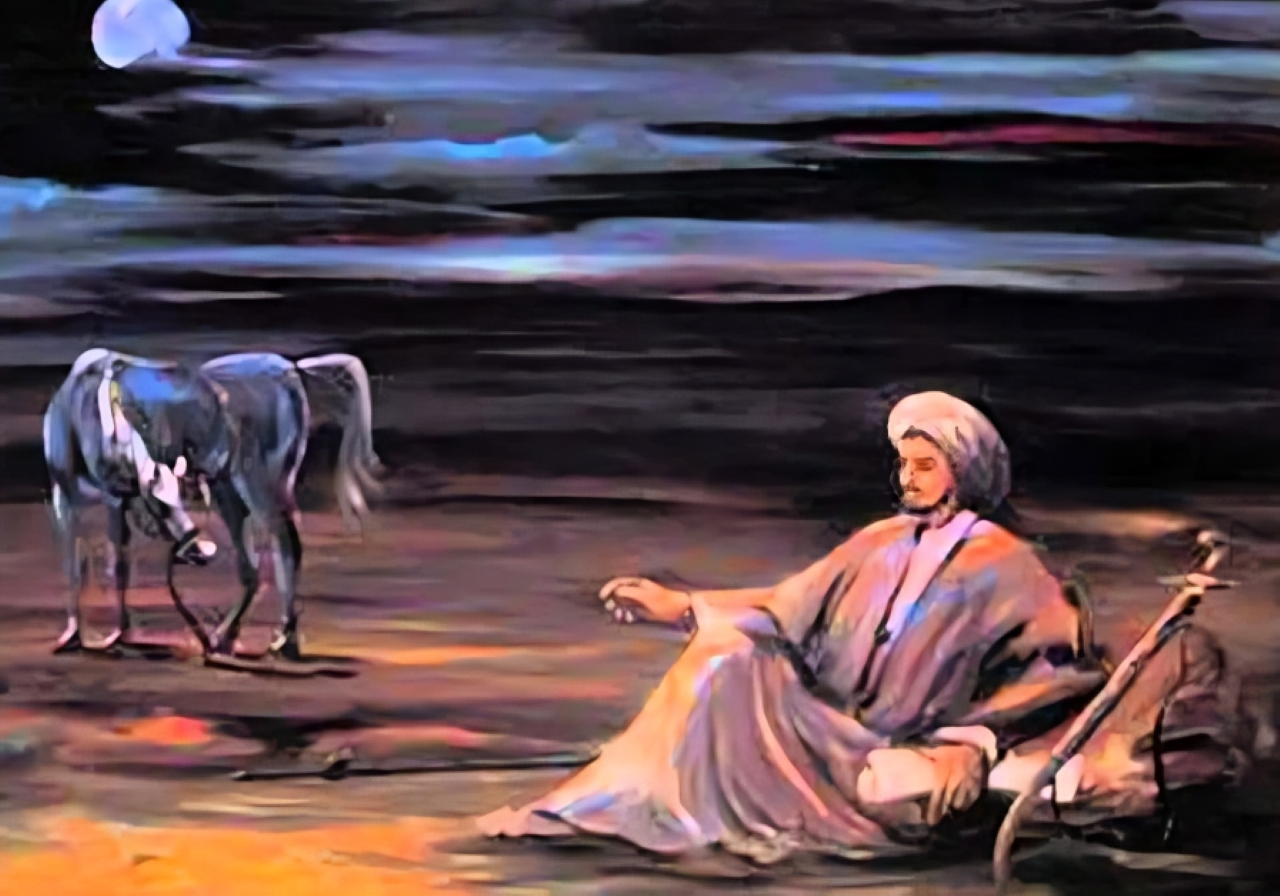
Arabic poetry (Arabic: الشعر العربي – ash-shi‘r al-‘arabīyy) stands as one of the most ancient, continuous, and influential poetic traditions in world literature. Long before prose writing, philosophical treatises, or historiography developed in the Arabic language, poetry served as the principal artistic, intellectual, and social medium of Arab society. It was not merely a literary form but a living institution—an archive of collective memory, a vehicle of moral values, and a weapon of persuasion.
The roots of Arabic poetry extend deep into antiquity. While written Arabic inscriptions dating back to the 1st century BCE already show poetic tendencies, scholars widely agree that oral Arabic poetry predates written records by centuries. In a predominantly oral culture, poetry functioned as the most reliable means of preserving history, genealogy, law, and ethical codes. A poet’s verse could immortalize a tribe’s glory or destroy its reputation.
Across more than fifteen centuries, Arabic poetry has evolved through multiple civilizations—pre-Islamic tribal society, Islamic empires, Andalusi courts, Sufi mysticism, colonial encounters, nationalist movements, and modern experimental forms—yet it has never lost its cultural prestige. Even today, poetry competitions fill stadiums, and verses circulate widely in music, politics, and social media.
Structural Foundations of Arabic Poetry
Poetry versus Prose
Classical Arabic literature distinguishes poetry into two primary forms:
- Measured and rhymed poetry
- Prose (including rhythmic or poetic prose)
Measured poetry overwhelmingly precedes prose in historical importance. For centuries, poetry was considered the highest form of expression, while prose was often regarded as secondary or functional.
Prosody and the Science of ‘Arūḍ
One of the defining features of Arabic poetry is its precise metrical system, known as ʿIlm al-ʿArūḍ (the Science of Prosody). This system was first systematically analyzed in the 8th century by al-Khalīl ibn Aḥmad al-Farāhīdī (711–786 CE), one of the greatest linguists of early Islamic civilization.
Al-Farāhīdī identified fifteen poetic meters, later expanded to sixteen by his student al-Akhfash. These meters are called buḥūr (literally “seas”), suggesting the rhythmic vastness and depth of poetic flow.
Each meter is constructed from repeated units called taf‘īlah, and each poetic line (bayt) must strictly adhere to its prescribed rhythmic pattern. Even a minor change—adding or removing a vowel or consonant—can shift a verse into an entirely different meter.
This rigorous system made Arabic poetry both highly structured and technically demanding. Mastery of meter was a sign of intellectual excellence, and poets were admired not only for emotional depth but for technical precision.
Monorhyme and Unity
Another hallmark of classical Arabic poetry is monorhyme. In most traditional poems—especially the qasīdah—every verse ends with the same rhyme (qāfiyah). While this may seem restrictive from a Western perspective, it aligns naturally with Arabic phonology, which has a limited vowel system and strong consonantal roots.
The unity of rhyme reinforced memorability, musicality, and rhetorical impact—essential qualities in an oral culture.
Pre-Islamic Arabic Poetry (Jāhiliyyah Poetry)
Poetry as Social Authority
In pre-Islamic Arabia, poetry occupied a position of unmatched importance. The poet (shaʿir) was not merely an artist; he was:
- A historian, recording battles and alliances
- A soothsayer, believed to be inspired by supernatural forces
- A propagandist, defending tribal honor
- A satirist, capable of humiliating enemies through verse
A powerful poem could ignite tribal pride or provoke conflict. As a result, poets wielded enormous influence, and their words carried lasting consequences.
Poetry Festivals and Public Performance
The most famous poetry gathering took place at ʿUkāẓ, a market town near Mecca. Here, poets from different tribes competed, reciting their finest compositions before judges and audiences. Victory at ʿUkāẓ brought immense prestige, and exceptional poems were celebrated across Arabia.
According to tradition, the most admired poems were displayed publicly—leading to the legendary Muʿallaqāt, often translated as “The Hanging Poems.”
The Rāwī Tradition and Oral Transmission
Poetry in pre-Islamic Arabia was transmitted orally. Each poet was often accompanied by a rāwī—a trained reciter and apprentice who memorized poems, explained them, and sometimes embellished their delivery.
This master-apprentice tradition formed unbroken poetic lineages. Famous chains include:
-
Ṭufayl → ʿAwās ibn Ḥajar → Zuhayr ibn Abī Sulmā → Kaʿb → al-Ḥuṭayʾah → Jamīl Buthaynah → Kuthayyir ʿAzza
This system ensured continuity, refinement, and preservation—later mirrored in Islamic traditions of Qurʾanic memorization.
Major Pre-Islamic Poets
Among the most celebrated poets of the pre-Islamic era are:
- Imruʾ al-Qays – Often regarded as the greatest pre-Islamic poet, known for emotional intensity and vivid imagery
- Zuhayr ibn Abī Sulmā – Renowned for wisdom, moral reflection, and clarity
- Ṭarafah ibn al-ʿAbd – Known for youthful rebellion and existential reflection
- Antarah ibn Shaddād – Warrior-poet celebrated for valor and love poetry
- Al-Nābighah al-Dhubyānī – Court poet noted for polished style
- Samawʾal ibn ʿĀdiyāʾ – Symbol of loyalty and honor
The Suʿlūk Poets
Another remarkable group were the suʿlūk poets—outlaws and vagabonds such as al-Shanfarā, Taʾabbata Sharran, and ʿUrwah ibn al-Ward. Their poetry rejected tribal rigidity, glorified solitude, freedom, and survival, and critiqued social injustice.
Major Pre-Islamic Anthologies
The Muʿallaqāt
The Muʿallaqāt represent the pinnacle of pre-Islamic poetry. Though traditionally said to be hung on the Kaʿbah, their true significance lies in literary excellence rather than physical display. Each poem exemplifies mastery of language, imagery, and structure.
The Mufaḍḍaliyāt
Compiled by al-Mufaḍḍal al-Ḍabbī, this anthology contains a broader, less selective range of poems, offering invaluable insight into the diversity of early Arabic poetic expression.
Stylistic Characteristics of Pre-Islamic Poetry
Fragmented Unity
Pre-Islamic poems often consist of loosely connected verses. Emphasis was placed on eloquence at the level of the line, rather than narrative cohesion across the whole poem.
The Nasīb and the Ruins Motif
Many poems begin with a nasīb, a nostalgic prelude in which the poet pauses at the ruins of a deserted campsite—al-wuqūf ʿalā al-aṭlāl (“standing by the ruins”). Here, memory, loss, and longing are evoked before transitioning to themes of travel, pride, or battle.
This motif became one of the most enduring conventions in Arabic poetry, influencing centuries of later verse.
Arabic Poetry in the Islamic Era
Continuity and Transformation
With the advent of Islam in the 7th century, Arabic poetry did not disappear; rather, it underwent ethical, thematic, and ideological transformation. While early Islam expressed reservations about poetry—particularly poetry that promoted tribal arrogance, immorality, or falsehood—the immense linguistic and cultural value of pre-Islamic verse ensured its preservation.
Indeed, Islamic scholars quickly realized that pre-Islamic poetry was indispensable for understanding classical Arabic grammar, vocabulary, idiom, and rhetoric. Since the Qur’an was revealed in eloquent Arabic, poetry became a critical tool for Qur’anic exegesis, philology, and jurisprudence.
As a result, Arabic poetry entered a new phase: Islamic poetry, where religious, moral, and philosophical themes coexisted with traditional poetic forms.
Preservation and Linguistic Authority
Early Muslim scholars collected poetry meticulously. This effort was driven by two primary motivations:
- Linguistic necessity – Poetry preserved the pure Arabic language needed to interpret the Qur’an accurately.
- Historical documentation – Poems recorded social customs, tribal conflicts, and moral codes of early Arab life.
Thus, poetry became a bridge between Jāhiliyyah culture and Islamic civilization.
Poetic Debates and Flytings (Naqāʾiḍ)
One of the most popular poetic forms in the early Islamic period was naqāʾiḍ—poetic duels in which two poets exchanged satirical attacks.
The most famous rivals were:
- Jarīr ibn ʿAṭiyyah
- al-Farazdaq
Their exchanges combined wit, insult, genealogy, and political commentary. These verbal duels were not mere entertainment; they reinforced tribal identity and sharpened rhetorical skill.
This tradition survives today in modified forms such as zajal, especially in Lebanon and other parts of the Arab world.
Court Poetry and Urban Sensibility
From Desert to Palace
As Arab society transitioned from tribal nomadism to urban empire, poetry adapted accordingly. The Umayyad and Abbasid courts fostered poets who wrote for patrons rather than tribes.
This shift produced several major changes:
- Themes moved from desert survival to luxury, love, wine, and philosophy
- Poetic life became increasingly urban and cosmopolitan
- Poets sought innovation, irony, and sophistication
Abu Nuwas: The Rebel Genius
Among court poets, Abu Nuwas stands as one of the most controversial and influential figures in Arabic literary history.
He revolutionized poetry by:
- Mocking traditional qasīdah conventions
- Writing openly about wine (khamriyyah) and homoerotic love
- Blending humor, irreverence, and lyrical beauty
Though his work often pushed religious boundaries, Abu Nuwas’s poetic brilliance ensured his lasting influence. His poetry reflects the cultural tensions of Abbasid society—between piety and pleasure, tradition and innovation.
Religious and Ethical Countercurrents
Not all court poetry was hedonistic. Poets such as Abu al-ʿAlāʾ al-Maʿarrī (often misrepresented as al-Alahijah in popular accounts) wrote deeply philosophical and morally introspective verse.
Some poets paid a heavy price for unorthodox ideas:
-
Ṣāliḥ ibn ʿAbd al-Quddūs was executed for heresy
-
Waddāḥ al-Yaman was executed, likely for political or personal transgression
Poetry remained powerful—and dangerous.
Sufi Poetry: Mysticism and Allegory
Poetry as Spiritual Language
Sufism, the mystical dimension of Islam, found a natural ally in poetry. Because mystical experience often defies literal language, symbolism, metaphor, and paradox became essential tools.
Sufi poets frequently used:
- Ghazal (love poetry)
- Khamriyyah (wine poetry)
—but reinterpreted them allegorically. Wine symbolized divine intoxication; the beloved represented God.
Major Sufi Poets
Some of the most influential Sufi poets include:
- Rābiʿa al-ʿAdawiyya – One of the earliest mystics, emphasizing pure love of God
- Bāyazīd al-Bisṭāmī – Known for ecstatic utterances
- Manṣūr al-Ḥallāj – Famously declared “Ana al-Ḥaqq” (“I am the Truth”)
Al-Ḥallāj’s words were interpreted as heretical, leading to his execution. Yet he later became a martyr figure in Sufi tradition, symbolizing ultimate spiritual union.
Badiʿ Poetry: Ornament and Complexity
The Rise of Rhetorical Artifice
As Arabic poetry matured, poets increasingly emphasized rhetorical sophistication, giving rise to badīʿ poetry—a style marked by:
- Metaphor and extended simile
- Wordplay and puns
- Juxtaposition of opposites
- Theological and philosophical allusions
Bashshār ibn Burd was instrumental in developing this style, which soon became a standard expectation among elite poets.
Praise and Criticism
Badīʿ poetry dazzled audiences but also provoked criticism. Some scholars argued that excessive ornamentation obscured emotional sincerity.
Literary debates ensued, notably involving figures such as Ibn Miskawayh and Ibn Burd, shaping Arabic literary criticism for centuries.
Christian Arabic Poetry
Pre-Islamic and Early Christian Verse
Arab Christians were composing poetry before Islam, often on biblical themes. Early examples include ʿAdī ibn Zayd, who wrote poems inspired by Christian theology.
Some historians suggest that Arabic poetry itself may have been practiced among Arab Christians even before widespread pagan poetic traditions.
Christian Poets under Islamic Rule
Under Islamic governance, Arab Christians continued writing poetry in Arabic. Notable figures include:
- Al-Akhtal al-Taghlibi – A Christian poet patronized by Umayyad caliphs
- Ibn al-Tilmīdh – A later Christian intellectual-poet
Though often avoiding overt religious themes, these poets contributed significantly to Arabic literary culture.
Christian Apologetics and Devotional Poetry
Arabic poetry was also used for Christian apologetics. In al-Andalus, Christian poets translated Psalms into Arabic verse, sometimes using rajaz meter, which resembled Christian iambic traditions.
A landmark figure is Sulaymān al-Ghazzī, the first author of a full diwan of Christian religious poetry in Arabic, consisting of over 3,000 lines across 97 qaṣīdas.
Andalusian Arabic Poetry (al-Andalus)
A Golden Age in Iberia
Arabic poetry flourished spectacularly in al-Andalus (Islamic Spain). Andalusian poets blended classical Arabic forms with new musicality, imagery, and emotional subtlety.
Major figures include:
- Ibn Zaydūn
- Wallāda bint al-Mustakfī
- Ibn ʿArabī
- Ibn Quzmān
- Abu al-Baqāʾ al-Rundī
Cross-Cultural Influence
Andalusian Arabic poetry existed in dialogue with Jewish Hebrew poetry, influencing figures such as Samuel ibn Naghrillah. This intercultural literary environment was unparalleled in medieval Europe.
Decline and Destruction
Arabic poetry in al-Andalus declined after the 13th century and suffered catastrophic loss following the Christian Reconquista. In 1499, Cardinal Jiménez de Cisneros ordered the burning of over one million Arabic volumes in Granada—a devastating blow to world heritage.
Major Poetic Genres in Arabic Poetry
Arabic poetry developed a rich system of genres, each serving a distinct social, emotional, or ideological function. These genres were not rigidly separated; rather, poets often blended them within a single work.
Madīḥ (Praise Poetry)
Madīḥ refers to eulogistic or panegyric poetry, typically composed to praise:
- Tribal leaders
- Rulers and caliphs
- Patrons and benefactors
- Prophets or religious figures
In pre-Islamic times, madīḥ reinforced tribal honor. In Islamic and courtly contexts, it became a tool of political legitimacy and patronage. Many poets depended economically on madīḥ, crafting eloquent praise to secure favor.
Hijāʾ (Satirical Poetry)
Hijāʾ is one of the most feared genres in Arabic literature. It involved biting satire, ridicule, and insult directed at:
- Rival poets
- Enemy tribes
- Political figures
Hijāʾ poetry could immortalize disgrace. Because poetry was memorized and publicly recited, a powerful satire could permanently damage reputation. This gave hijāʾ extraordinary social power and explains the popularity of naqāʾiḍ (satirical duels).
Themes in hijāʾ often included:
- Cowardice
- Moral corruption
- Illegitimacy
- Sexual impropriety
Rithāʾ (Elegy)
Rithāʾ is elegiac poetry mourning the dead. It is among the most emotionally sincere forms of Arabic poetry and was often composed by women as well as men.
Elegies expressed:
- Grief and loss
- Praise of the deceased
- Reflections on fate and mortality
Famous elegists include al-Khansāʾ, whose laments for her brothers are among the most moving works in Arabic poetry.
Wasf (Descriptive Poetry)
Wasf focuses on vivid description, portraying:
- Nature
- Animals (especially camels and horses)
- Battle scenes
- Architecture and gardens
In pre-Islamic poetry, wasf demonstrated a poet’s observational precision and mastery of language. Later poets extended wasf to urban settings, palaces, and even abstract concepts.
Ghazal (Love Poetry)
Ghazal is one of the most enduring genres of Arabic poetry. It expresses love, longing, separation, and desire.
Two main types emerged:
- Chaste ghazal – Idealized, often unfulfilled love
- Erotic ghazal – Sensual and explicit, especially in Abbasid court poetry
Ghazal later became central to Sufi poetry, where earthly love symbolized divine longing.
Khamriyyah (Wine Poetry)
Khamriyyah celebrates wine, intoxication, and revelry. While controversial under Islamic law, wine poetry flourished as metaphor, rebellion, and aesthetic expression.
In Sufi poetry, wine symbolized:
- Divine knowledge
- Spiritual ecstasy
- Loss of ego
Abu Nuwas is the undisputed master of this genre.
Fakhr (Boasting)
Fakhr involves self-praise or praise of one’s tribe, lineage, or achievements. In tribal societies, fakhr reinforced social hierarchy and honor.
In later periods, fakhr evolved into:
-
Personal pride in artistic skill
-
Intellectual or moral superiority
Ḥamāsah (War Poetry)
Ḥamāsah celebrates courage, battle, heroism, and sacrifice. It was closely tied to tribal warfare and later to religious and nationalist struggles.
This genre re-emerged strongly in modern political poetry, especially during anti-colonial movements.
Tardiyyah (Hunting Poetry)
Tardiyyah describes hunting expeditions, animals, and the thrill of pursuit. It reflects aristocratic leisure and control over nature, particularly in courtly contexts.
Khawāl (Homiletic Poetry)
Khawāl refers to didactic or moralizing poetry, often conveying:
- Ethical instruction
- Religious reflection
- Social critique
This genre was common among ascetic and religious poets.
Poetic Forms and Structural Units
The Bayt (Verse)
The fundamental unit of Arabic poetry is the bayt, consisting of two hemistiches:
- Ṣadr (first half)
- ʿAjuz (second half)
Each bayt is metrically complete and can often stand alone, contributing to the modular nature of Arabic poetry.
Qasīdah
The qasīdah is the most iconic Arabic poetic form. It is a long, monorhymed ode traditionally composed of three main sections:
- Nasīb – Nostalgic prelude (often love or ruins)
- Raḥīl – Journey or desert imagery
- Madīḥ / Fakhr / Hijāʾ – The main thematic purpose
The monorhyme gives the qasīdah immense formal discipline and musicality.
Qitʿah
A qitʿah is a shorter poem focused on a single event or idea, lacking the elaborate structure of a qasīdah. It was often used for satire, elegy, or epigrammatic expression.
Muwashshaḥ
The muwashshaḥ emerged in al-Andalus and broke from strict monorhyme. It featured:
- Strophic structure
- Musical refrains
- Occasionally Romance-language endings (kharja)
It had strong influence on later European lyric poetry.
Rubāʿī (Quatrain)
The rubāʿī consists of four lines, often philosophical or reflective. Though more prominent in Persian poetry, it also appears in Arabic traditions.
Rajaz
Rajaz is a rhythmic, chant-like meter used for:
- Didactic poetry
- Improvisation
- Lexicography
Its flexibility made it useful for oral performance.
Classical Prosody: ʿIlm al-ʿArūḍ
Al-Khalīl ibn Aḥmad al-Farāhīdī
Arabic prosody was systematized by al-Khalīl ibn Aḥmad al-Farāhīdī, who identified fifteen meters, later expanded to sixteen.
These meters are called buḥūr (“seas”), reflecting the rhythmic flow of poetry.
Tafʿīlah and Meter
Each meter consists of repeating units called tafʿīlah. The poet must adhere strictly to these patterns.
Even a minor alteration in vowel length or consonant placement can shift a poem into a different meter—making Arabic poetry technically demanding.
Qāfiyah (Rhyme)
Arabic poetry traditionally employs monorhyme, where every bayt ends with the same consonant-vowel pattern.
This system emphasizes:
- Phonetic mastery
- Lexical creativity
- Structural coherence
Vernacular and Folk Poetry (Malḥūnah)
Alongside literary Arabic poetry (fuṣḥā), a rich tradition of vernacular poetry developed.
Forms include:
- Zajal (popular verse duels)
- Nabati poetry (Bedouin oral tradition)
- Mawwal / Mawāliyyā
- Humayni (Yemen)
These forms preserved local identity and oral creativity outside elite literary culture.
The Arab Renaissance (al-Nahḍah)
Historical Background
The Arab Renaissance (al-Nahḍah) began in the early 19th century and marked a profound transformation in Arabic intellectual, literary, and cultural life. It emerged in response to:
- European colonial expansion
- Contact with Western education and literature
- Political decline of the Ottoman Empire
- Printing presses and translation movements
Poetry, as the most prestigious literary form in Arabic culture, became a central arena for renewal and debate.
The Call for Renewal
Writers of the Nahḍah believed that Arabic literature had stagnated due to excessive imitation (taqlīd) of classical forms. They called for:
- Revival of creativity (ijtihād)
- New themes addressing modern society
- Engagement with Western literary forms
- Reform of language and style
Yet, this renewal was not a rejection of the classical tradition but rather a dialogue with it.
Early Reformers of Arabic Poetry
Key early figures included:
- Rifāʿa al-Tahtāwī – Introduced European literary ideas through translation
- Ahmad Faris al-Shidyaq – Experimented with language and satire
- Butrus al-Bustani – Promoted linguistic and cultural revival
- Francis Marrash – Pioneer of poetic prose and modern themes
Francis Marrash’s poetic prose, particularly Mashhad al-Aḥwāl (1870), is often cited as a turning point toward modern Arabic poetry.
Neoclassicism in Arabic Poetry
Revival of Classical Forms
The Neoclassical movement sought to restore the grandeur of classical Arabic poetry while adapting it to modern realities.
Its key characteristics included:
- Strict adherence to classical meters
- Use of the qasīdah form
- Elevated language
- Engagement with contemporary political and social issues
Major Neoclassical Poets
Notable figures include:
- Mahmoud Sami al-Baroudi – Considered the founder of Arabic Neoclassicism
- Ahmad Shawqi – Known as the “Prince of Poets”
- Hafiz Ibrahim – The “Poet of the Nile”
- Jamil Sidqi al-Zahawi (Iraq)
- Maʿrūf al-Rusāfī (Iraq)
- Ibrahim Tuqan (Palestine)
These poets used poetry to express:
- Nationalism
- Anti-colonial resistance
- Cultural pride
- Social reform
Poetry and Politics
Neoclassical poetry was deeply political. Poets praised reformers, criticized tyranny, and mourned national defeats.
However, this political engagement often led to:
- Censorship
- Exile
- Imprisonment
Poetry once again became a public moral voice, much like in pre-Islamic times.
Romanticism in Arabic Poetry
Emergence of Romanticism
Arabic Romanticism flourished between the 1920s and 1940s, influenced by:
- English Romantic poets (Wordsworth, Shelley, Keats)
- French Romanticism
- Individual emotional expression
Romantic poets rejected rigid classical imitation and emphasized emotion, nature, and individuality.
Core Characteristics of Arabic Romantic Poetry
Romantic Arabic poetry emphasized:
- Personal emotion and subjectivity
- Love and longing
- Nature as a spiritual refuge
- Melancholy, alienation, and introspection
- Revolt against social conventions
The Mahjar (Émigré) School
The Mahjar School consisted of Arab poets who emigrated to North and South America.
Major figures include:
- Ameen Rihani
- Kahlil Gibran
- Mikhail Naimy
- Elia Abu Madi
- Nasib Arida
Their poetry blended:
- Arabic literary heritage
- Western Romanticism
- Mysticism and humanism
Kahlil Gibran’s lyrical simplicity and spiritual symbolism influenced generations of Arab readers.
Romantic Poets in the Arab World
Prominent Romantic poets across Arab countries include:
- Abdel Rahman Shokry (Egypt)
- Abbas Mahmoud al-Aqqad (Egypt)
- Ibrahim al-Mazni (Egypt)
- Omar Abu Risha (Syria)
- Elias Abu Shabaki (Lebanon)
- Abu al-Qasim al-Shabbi (Tunisia)
- Al-Tijani Yusuf Bashir (Sudan)
Their poetry explored inner turmoil, love, despair, and freedom.
The Apollo Society
Formation and Influence
In 1932, Ahmed Zaki Abu Shadi founded the Apollo Society in Cairo and published the magazine Apollo.
Members included:
- Ibrahim Nagi
- Ali Mahmoud Taha
- Abu al-Qasim al-Shabbi
The group promoted:
- Emotional sincerity
- Musical language
- Symbolism and imagination
- Limited experimentation with form
Transition Toward Modernism
While still largely committed to classical meters, Apollo poets paved the way for:
- Symbolism
- Free verse
- Psychological depth
They served as a bridge between Romanticism and modernist experimentation.
Symbolism in Arabic Poetry
Origins and Characteristics
Arabic Symbolism developed alongside Romanticism, inspired by French Symbolist poets.
Its key features include:
- Dense imagery
- Ambiguity
- Suggestion rather than direct statement
- Musical language
Major Symbolist Poets
Important Symbolist poets include:
- Adib Mashar (Lebanon)
- Yusuf Ghusub (Lebanon)
- Said Akl (Lebanon)
- Bishr Faris (Egypt)
Some Symbolists advocated radical reforms, including writing Arabic in Latin script—an idea that remained controversial.
Symbolism as a Gateway to Modernism
Symbolism encouraged:
- Experimentation with metaphor
- Psychological depth
- Non-linear meaning
These innovations prepared Arabic poetry for the modernist revolution that would follow World War II.
The Rise of Modernism in Arabic Poetry
Historical Context
The emergence of Modernist Arabic poetry after World War II marked one of the most radical transformations in the history of Arabic literature. The devastation of war, the collapse of colonial empires, the Palestinian Nakba (1948), and the rise of revolutionary ideologies created an atmosphere of crisis and questioning.
Traditional poetic forms—once capable of expressing communal values—were increasingly seen as inadequate for capturing:
- Existential anxiety
- Political disillusionment
- Fragmented identity
- Rapid social change
Modernist poets sought new forms, rhythms, and languages to articulate these experiences.
Free Verse (Shi‘r Ḥurr)
Breaking the Bayt
Classical Arabic poetry was built on the bayt (a verse composed of two symmetrical hemistichs). Modernists challenged this structure.
In 1947, two Iraqi poets—
- Badr Shakir al-Sayyab
- Nazik al-Malaika
initiated the free verse revolution by abandoning the fixed bayt while retaining:
- Classical meters
- Rhythmic repetition
- Variable line lengths
This innovation allowed greater expressive freedom while maintaining a link to Arabic prosody.
Thematic Innovations
Free verse poetry introduced themes previously marginal or taboo:
- Alienation and exile
- Psychological fragmentation
- Myth as political allegory
- Death, despair, and rebirth
Al-Sayyab’s use of Mesopotamian myth and symbolism exemplified this transformation.
Resistance and Debate
The free verse movement faced intense opposition from traditional critics who argued that:
- Meter and rhyme were essential to poetry
- Free verse was prose disguised as poetry
Despite controversy, free verse became dominant across the Arab world by the 1960s.
Prose Poetry (Qaṣīdat al-Nathr)
Definition and Characteristics
Prose poetry represents a more radical break from tradition. It rejects:
- Meter
- Rhyme
- Classical prosodic constraints
Instead, it relies on:
- Rhythm of thought
- Image density
- Musicality of language
Pioneers of Prose Poetry
Key figures include:
- Muhammad al-Maghut
- Tawfiq Sayigh
- Jabra Ibrahim Jabra
Their poetry blurred boundaries between poetry and prose, emphasizing:
- Irony
- Absurdity
- Political protest
Beirut as a Cultural Center
Beirut became the epicenter of modernist experimentation due to:
- Relative freedom of expression
- Cosmopolitan intellectual life
Two influential literary journals emerged:
- Shi‘r (1957) – Founded by Yusuf al-Khal and Adonis
- Al-Adab (1953) – Promoted engaged literature
These journals introduced global modernist trends into Arabic poetry.
Adonis and Radical Poetic Innovation
Reimagining Arabic Poetics
Adonis (Ali Ahmad Said) is one of the most influential figures in modern Arabic poetry. He called for:
- Deconstruction of classical heritage
- Reinterpretation of Arab-Islamic history
- A poetic language free from dogma
Language and Myth
Adonis used:
- Ancient myths
- Sufi symbolism
- Fragmented syntax
His poetry challenges linear meaning, encouraging readers to actively construct interpretation.
Controversy and Influence
Though controversial for his radical ideas, Adonis reshaped Arabic poetic discourse and influenced generations of poets across the Arab world and diaspora.
Surrealism in Arabic Poetry
Early Experiments
Surrealist elements entered Arabic poetry through:
- Egyptian avant-garde movements
- European literary influence
The Art et Liberté group (1938–1948) opposed fascism and promoted artistic freedom, though many members wrote in European languages.
Arabic-Language Surrealism
True Arabic surrealism emerged in works by:
- Orkhan Muyassar
- Adonis
Surrealist poetry explored:
- Dreams
- The unconscious
- Fragmented reality
Poetry of Commitment (Iltizām)
Literature and Political Responsibility
From the 1950s onward, many Arab poets believed poetry should engage directly with political and social struggles.
This movement, known as iltizām, emphasized:
- Anti-imperialism
- Social justice
- Resistance
Major Poets of Commitment
Notable figures include:
- Abd al-Wahhab al-Bayyati
- Mahmoud Darwish
- Khalil Hawi
- Tawfiq Ziad
Their poetry became inseparable from national and revolutionary movements.
Poetry and Exile
Many committed poets experienced:
- Censorship
- Exile
- Surveillance
Exile itself became a central poetic theme—both physical and existential.
Palestinian Poetry as Resistance
Poetry after the Nakba
The Palestinian catastrophe of 1948 transformed Arabic poetry profoundly.
Poetry became:
- A repository of collective memory
- A weapon of resistance
- A means of preserving identity
Mahmoud Darwish
Mahmoud Darwish is widely regarded as the Palestinian national poet.
His work blends:
- Personal lyricism
- Political struggle
- Universal human themes
Darwish’s poetry transcended propaganda, achieving global resonance.
Poetic Language of Defiance
Poems such as Tawfiq Ziad’s Here We Will Stay articulated defiance, endurance, and rootedness, turning poetry into an act of survival.
Contemporary Arabic Poetry: Late 20th Century to Present
A Changing World, A Changing Poetics
From the 1970s onward, Arabic poetry entered a phase of plurality rather than dominance by a single school. Political defeats, civil wars, authoritarian regimes, exile, globalization, and digital media reshaped both poetic content and form.
Poets no longer felt compelled to choose between:
- Classical poetry
- Free verse
- Prose poetry
Instead, contemporary Arabic poetry became hybrid, fluid, and experimental.
Neo-Sufi Tendencies in Modern Arabic Poetry
Spirituality Beyond Orthodoxy
A notable trend since the 1970s has been the revival of Sufi imagery and metaphysics, often detached from formal religion and combined with:
- Existentialism
- Marxism
- Postmodern skepticism
This neo-Sufi poetry uses mystical language to explore:
- Alienation
- Loss
- Identity
- Transcendence
Political Mysticism
For some poets, Sufism became a symbolic refuge against:
- Political repression
- Ideological rigidity
- Cultural fragmentation
Thus, mystical metaphors often coexist with revolutionary or dissenting ideas.
Poetry and Exile
The Poet as Exile
Exile—forced or voluntary—has become one of the defining experiences of modern Arab poets. Cities such as:
- Beirut
- Paris
- London
- Berlin
- New York
became new poetic landscapes.
Themes of exile include:
- Displacement
- Memory
- Loss of language
- Fragmented identity
Writing Between Languages
Many contemporary poets write:
- In Arabic while living abroad
- Or bilingually
This has enriched Arabic poetry with:
- New metaphors
- Cross-cultural references
- Hybrid sensibilities
Women’s Voices in Contemporary Arabic Poetry
From Margins to Center
Although women poets existed in earlier eras, the modern period witnessed an unprecedented rise in female poetic voices addressing:
- Gender
- Body
- Desire
- Oppression
- War
Breaking Taboos
Contemporary women poets challenge:
- Patriarchal norms
- Social silence
- Linguistic constraints
They use poetry as:
- Testimony
- Protest
- Self-definition
Their work expands the emotional and thematic range of Arabic poetry.
Poetry, Media, and Popular Culture
Television Poetry Competitions
In recent decades, poetry has entered mass media through televised competitions such as:
- Prince of Poets (classical Arabic poetry)
- Million’s Poet (Nabati poetry)
These programs:
- Revived public interest in poetry
- Reintroduced classical meters to younger audiences
- Turned poets into celebrities
Poetry and Song
Arabic poetry continues to influence popular music. Many modern songs draw lyrics from:
- Classical poems
- Contemporary verse
- Romantic and political poetry
This fusion keeps poetry alive beyond literary circles.
Digital Age and Social Media Poetry
New Platforms, New Audiences
Social media has transformed poetic circulation. Platforms like:
- YouTube
allow poets to bypass traditional publishers and reach millions instantly.
Democratization and Challenges
While digital platforms democratize poetry, they also raise concerns:
- Decline in formal discipline
- Overemphasis on emotional immediacy
- Loss of depth and craft
Nonetheless, digital poetry represents a new phase of oral–written hybridity, echoing pre-Islamic oral traditions.
Arabic Poetry and Translation
The Challenge of Translation
Arabic poetry is among the most difficult to translate due to:
- Complex prosody
- Wordplay
- Cultural allusions
Much of the poetic beauty lies in:
- Sound
- Rhythm
- Morphology
Global Reception
Despite these challenges, Arabic poetry has gained international recognition through:
- Translations
- Academic studies
- Global literary festivals
Poets like Mahmoud Darwish, Adonis, and Nizar Qabbani are widely read beyond the Arab world.
Enduring Themes of Arabic Poetry
Across fourteen centuries, Arabic poetry has consistently explored:
- Love and longing
- Praise and satire
- Faith and doubt
- Power and resistance
- Time, loss, and mortality
Despite changes in form, these themes remain central.
Continuity and Innovation
Arabic poetry represents a rare balance between:
- Deep respect for tradition
- Bold innovation
Unlike many literary traditions that break completely from the past, Arabic poetry continuously reinterprets its heritage.
Arabic Poetry as a Living Civilization
Arabic poetry is not merely a literary genre—it is:
- A historical archive
- A linguistic laboratory
- A spiritual quest
- A political weapon
- A cultural memory
From pre-Islamic desert odes to modern prose poetry, Arabic poetry has survived:
- Empires
- Religious transformations
- Colonialism
- War
- Exile
Its endurance lies in its adaptability and its unwavering belief in the power of language.
As long as Arabic is spoken, sung, whispered, and written, Arabic poetry will remain alive—renewing itself while remembering its ancient voice.